sparkles.base.text — cell-splitting & width specification
Abstract
This page records the delivered terminal cell policy and its curated conformance baseline. The owned UTF/Unicode specification defines the production foundation and expanded target contracts, and wrapping and measurement defines the shared line-selection and source-preserving plan contracts. Their delivery status and remaining cutover gates are tracked in the delivery plan; a target requirement alone is not evidence that its implementation has shipped.
sparkles:base measures text the way a grapheme-clustering terminal lays it out: how many grid cells each user-perceived character occupies, where one character ends and the next begins, and how a line of styled text wraps without splitting a wide character or bleeding colour onto the next line. This page specifies the delivered terminalKitty cell policy, the width policy kitty's text-sizing protocol defines, and its conformance baseline against the Unicode test corpora and independent terminal and library implementations. A separate specification covers the owned production foundation and its expanded target contracts, built on Unicode data and algorithms that sparkles implements itself.
Introduction
A terminal user interface draws text into a grid. Every column, border, cursor position and selection depends on knowing how many grid cells a string advances the cursor by. That number is not the string's length in bytes or code points. A flag is two code points in two cells, an accented letter can be two code points in one cell, and a family emoji is five code points that a clustering terminal draws in two.
No single authority settles the width of every character. The Unicode East Asian Width property leaves many characters ambiguous, emoji presentation depends on variation selectors, and terminals and width libraries disagree on whole classes of input. A measurement library that does not name the policy it follows inherits those disagreements as misaligned borders and drifting cursors.
This library follows one named policy: kitty's Text Sizing Protocol algorithm for splitting text into cells, as kitty's implementation applies it. Each grapheme cluster occupies one or two adjacent grid cells. How many is set by the cluster's leading scalar (its first Unicode code point) and adjusted only by emoji variation selectors. That policy is the terminalKitty width profile. ANSI escape sequences (colour and hyperlink codes, measured as zero width) and line wrapping are sparkles extensions layered on the same measurement.
This page is the accepted contract of the delivered terminal cell policy. The owned UTF, Unicode, and cell text specification defines the production foundation and expanded target contracts. It keeps terminalKitty as a named, revisioned width profile and adds the per-scalar terminalUnclustered profile. The production foundation derives every property from one Unicode release whose data and algorithms sparkles implements itself (owned semantics), instead of from the toolchain's tables. Its cell text contract cites this page for the delivered width classes. Delivery and review of the expanded width-profile, glyph-channel, and scaled-footprint requirements remain separate gates in the delivery plan; this page does not mark those requirements implemented or reviewed. The shared line-selection contracts live in wrapping and measurement. Fonts, shaping and proportional layout are out of scope here.
Sections 2–8 define the measurement model, decoding, per-code-point and per-cluster width, variation selectors and segmentation; §9 and §10 the styled text and wrapping extensions; §11 the conformance summary. The curated cases live in test cases, exhaustive differential testing in the conformance harness, and usage in sparkles:base.
Contract at a glance
- A string's visible width equals the number of grid cells kitty advances the cursor by when printing it, with escapes excluded.
- A grapheme cluster's width is its leading scalar's width, never the sum of its members; VS16 and VS15 adjust it only on an emoji-variation base.
- Marks (
M*) and format characters (Cf) are width zero; symbols (S*) are width one, following kitty's implementation rather than its prose. - Ill-formed UTF-8 decodes to
U+FFFDwithout throwing or allocating. - Wrapping never lets a wide cluster straddle the wrap column.
- Every runnable example on this page is CI-verified against its recorded output.
1. Scope & credits
The terminal policy uses the following owned modules of sparkles.base.text:
utf.d,utf8.d,utf16.d: bounded scalar decoding, conversion, and explicit malformed-input policies.unicode_tables.d: manifest-identified categories, boundary properties, East Asian width, and emoji variation bases.width.d: the named terminal-cell profile (codepointWidth,graphemeClusterWidth,unclusteredWidth).grapheme.d: default extended-grapheme state and streaming spans; styled UTF-8 measurement (byGraphemeCluster,visibleWidth).wrap.d,wrap_plan.d,wrap_cells_project.d: cell wrapping, source-preserving plans, and validated emission.
The width model is inspired by kitty. Quoted passages in this document are taken from kitty's documentation and source, © Kovid Goyal, licensed GPL-3.0:
- The prose spec —
docs/text-sizing-protocol.rst, section "The algorithm for splitting text into cells" (online). - The width-class implementation —
gen/wcwidth.py(the generator that emits kitty's character-property tables).
NOTE
kitty's quoted algorithm document states that it is based on Unicode 16. sparkles' production decoding, segmentation, categories, and width properties use owned code and one authenticated Unicode 18.0.0 manifest: libs/base/tools/unicode/manifest.json. The manifest-driven generator libs/base/tools/gen_unicode_tables.d reads authenticated local inputs from libs/base/tools/unicode/18.0.0; ordinary generation does not download data. Phobos and installed foreign Unicode versions do not select production semantics. The conformance harness distinguishes normative Unicode 18 checks from foreign terminal-policy comparisons.
2. Measurement model vs. kitty's placement model
kitty's algorithm is written for a terminal that places decoded scalars into a cursor-addressed grid of cells. sparkles.base.text is a measurement and layout library: it does not own a grid or interpret cursor-motion effects. CellPolicy.terminalKitty, revision 1, is its named local cell profile:
- one measured grapheme cluster occupies 0, 1, or 2 terminal columns;
visibleWidthsums those cluster widths, excluding escape units;- combining members do not add advance to the leading scalar's cell width; eligible presentation selectors can adjust that width.
This models the curated kitty-inspired cases, not every terminal's actual cursor advance (see §6 and §9). Walking the clusters and advancing a column counter reproduces visibleWidth:
#!/usr/bin/env dub
/+ dub.sdl:
    name "spec_text_model"
    dependency "sparkles:base" version="*"
+/
import std.stdio : writefln;
import sparkles.base.text.grapheme : byGraphemeCluster, visibleWidth;

void main()
{
    const s = "a❤️世\U0001F1FA\U0001F1F8"; // ascii, emoji+VS16, CJK, flag
    size_t col;
    foreach (u; s.byGraphemeCluster)
    {
        if (u.isEscape)
            continue;
        writefln("cells [%s..%s)  %s", col, col + u.width, u.slice.idup);
        col += u.width;
    }
    writefln("cursor advanced %s cells; visibleWidth = %s", col, visibleWidth(s));
}
cells [0..1) a
cells [1..3) ❤️
cells [3..5) 世
cells [5..7) 🇺🇸
cursor advanced 7 cells; visibleWidth = 7Visual: a crisp cell grid
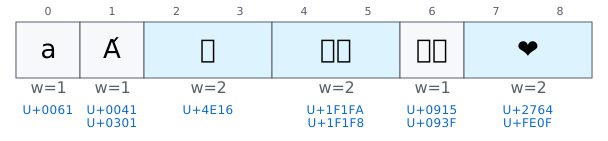
The same idea as a figure — each cluster boxed over the cells it occupies (wide clusters shaded, spanning two), with its code points beneath. It is generated from the real byGraphemeCluster segmentation by libs/base/examples/text-cell-svg.d and regenerated by a pre-commit hook, so it stays in lock-step with the algorithm:
Try it: interactive cell explorer
Type any string below and watch it split into cells. This runs the real sparkles.base.text — compiled to WebAssembly (wasm32, full Phobos) by nix build .#text-wasm and calling the actual byGraphemeCluster / visibleWidth in your browser, not a reimplementation.
3. Decoding (safe UTF-8)
A terminal using this algorithm must decode the bytes they receive into Unicode scalar values (i.e., code points except surrogates) using UTF-8. When it encounters any UTF-8 ill-formed subsequences, it must replace each maximal subpart of the ill-formed subsequence with a
U+FFFD REPLACEMENT CHARACTER(�).— kitty Text Sizing Protocol
grapheme.d uses owned decodeToken with UtfMode.replacement. It emits one U+FFFD per Unicode maximal subpart, retains that token's consumed source span, and never absorbs a following independently valid token. For example, E1 80 41 becomes one replacement for bytes [0,2) followed by A; final ED A0 80 becomes three replacements. This grouping is pinned by the owned UTF contract, not by Phobos.
U+FFFD is East-Asian ambiguous and has width 1 in the named cell profile. The scanner remains @safe pure nothrow @nogc; ClusterMeasure.hasMalformed marks replacement-decoded clusters. Its slice still borrows the original bytes, so callers must not mistake malformed source bytes for rendered valid UTF-8.
#!/usr/bin/env dub
/+ dub.sdl:
    name "spec_text_decoding"
    dependency "sparkles:base" version="*"
+/
import std.stdio : writefln, writeln;
import std.string : representation;
import sparkles.base.text.grapheme : byGraphemeCluster, visibleWidth;

void main()
{
    // 'a', 'b', then one ill-formed byte 0xFF -> decoded as U+FFFD (width 1).
    const char[] bytes = ['a', 'b', '\xFF'];
    foreach (u; bytes.byGraphemeCluster)
        writefln("bytes=%(%02x %)  width=%s", u.slice.representation, u.width);
    writeln("visibleWidth = ", visibleWidth(bytes));
}
bytes=61 width=1
bytes=62 width=1
bytes=ff width=1
visibleWidth = 34. The per-code-point pipeline
kitty specifies, for each decoded code point:
- First check if the code point is an ASCII control code, and handle it appropriately. ASCII control codes are the code points less than
U+0032and the code pointU+0127 DEL. The code pointU+0000 NULmust be discarded.- Next, check if the code point is invalid, and if it is, discard it … Invalid code points are code points with Unicode category
Cc or Csand 66 additional code points:[0xfdd0, 0xfdef],[0xfffe, 0x10ffff-1, 0x10000]and[0xffff, 0x10ffff, 0x10000].- Next, check if there is a previous cell …
- Next, calculate the width in cells of the received code point, which can be 0, 1, or 2 …
- If there is no previous cell and the code point's width is zero, the code point is discarded …
- If there is a previous cell, the Grapheme segmentation algorithm UAX29-C1-1 is used to determine if there is a grapheme boundary …
- If there is no boundary, the current code point is added to the previous cell …
- If there is a boundary, but the width of the current code point is zero, it is added to the previous cell …
- The code point is added to the current cell and the cursor is moved forward (right) by either 1 or 2 cells …
— kitty Text Sizing Protocol
NOTE
The thresholds U+0032 and U+0127 DEL in step 1 are apparent typos in kitty's prose for U+0020 (space) and U+007F (DEL). sparkles uses owned generalCategory data (GeneralCategory.Cc), plus its ASCII fast path, to measure the C0 (U+0000–U+001F), DEL, and C1 controls as width 0.
As a diagram (one decoded code point flowing through the nine steps):
The diagram illustrates the quoted kitty placement algorithm, not a VT engine implemented by sparkles.
sparkles segments an escape-free run with owned GraphemeBreakState, then derives each cluster's width with graphemeClusterWidth (§6). codepointWidth assigns noncharacters, controls, and the profile's zero-width classes width 0; it does not remove their source bytes. In particular, isNoncharacter recognizes U+FDD0..U+FDEF and every U+xxFFFE/U+xxFFFF. A standalone zero-width cluster remains addressable even though it advances no cells.
Decomposing a cluster into its scalars shows steps 4–9 at work: each scalar has an isolated width (step 4), zero-width members attach to the cell (steps 7–8), and the cell advances by the leading scalar's width — a flag's two width-2 indicators still make one 2-cell cell, never four:
#!/usr/bin/env dub
/+ dub.sdl:
    name "spec_text_pipeline"
    dependency "sparkles:base" version="*"
+/
import std.stdio : writefln;
import std.array : appender;
import std.format : format;
import sparkles.base.text.grapheme : GraphemeBreakState;
import sparkles.base.text.width : codepointWidth, graphemeClusterWidth;

void main()
{
    static struct C { string label; dstring s; }
    static immutable C[] cs = [
        C("A + combining acute", "Á"d),
        C("flag (RI + RI)",      "\U0001F1FA\U0001F1F8"d),
        C("Devanagari की",       "की"d),
    ];
    void report(string label, const(dchar)[] cluster)
    {
        auto scalars = appender!string;
        foreach (k, cp; cluster)
            scalars ~= format("%sU+%04X(w%s)", k ? " " : "", cp, codepointWidth(cp));
        writefln("%-22s %s -> cell width %s", label, scalars[],
            graphemeClusterWidth(cluster));
    }
    foreach (c; cs)
    {
        GraphemeBreakState state;
        size_t start;
        foreach (i, cp; c.s)
            if (state.push(cp) && i != 0)
            {
                report(c.label, c.s[start .. i]);
                start = i;
            }
        if (start < c.s.length)
            report(c.label, c.s[start .. $]);
    }
}
A + combining acute U+00C1(w1) -> cell width 1
flag (RI + RI) U+1F1FA(w2) U+1F1F8(w2) -> cell width 2
Devanagari की U+0915(w1) U+0940(w0) -> cell width 15. Width of a single code point
kitty assigns width by these classes, in decreasing priority:
- Regional indicators: 26 code points starting at
0x1F1E6. These all have width 2.- Doublewidth: … All code points marked
WorF[inEastAsianWidth.txt] have width two. All code points in the following ranges have width two unless they are marked asA:[0x3400, 0x4DBF], [0x4E00, 0x9FFF], [0xF900, 0xFAFF], [0x20000, 0x2FFFD], [0x30000, 0x3FFFD].- Wide emoji: … All
Basic_Emojihave width two unless they are followed byFE0Fin the file. The leading codepoints in allRGI_Emoji_Modifier_SequenceandRGI_Emoji_Tag_Sequencehave width two. All code points inRGI_Emoji_Flag_Sequencehave width two.- Marks: These are all zero width code points. They are code points with Unicode categories whose first letter is
MorS. Additionally, code points with Unicode categoryCf. Finally, they include all modifier code points fromRGI_Emoji_Modifier_Sequence…- All remaining code points have a width of one cell.
— kitty Text Sizing Protocol
IMPORTANT
Prose vs. implementation for rule 4. kitty's implementation does not treat category S as zero width. gen/wcwidth.py puts only M*, Cf, Other_Default_Ignorable_Code_Point, and emoji modifiers into marks (width 0); code points with a category starting in S go to a separate symbols set and keep the default width 1:
if category.startswith('M'):
    marks.add(codepoint)         # M* -> width 0
elif category.startswith('S'):
    all_symbols.add(codepoint)   # S* -> NOT marks (width 1)
elif category == 'Cf':
    marks.add(codepoint)         # Cf -> width 0
So + (U+002B, category Sm) is width 1, not 0. sparkles follows the implementation: codepointWidth returns 1 for symbols.
The same priority order resolves emoji skin-tone modifiers (U+1F3FB..U+1F3FF): the prose lists them under Marks, but they have East_Asian_Width = W, and Doublewidth (rule 2) outranks Marks (rule 4) — so a modifier in isolation is width 2. It only contributes 0 inside a cluster, where the leading emoji already sets the width.
As a decision tree — the first matching class wins (codepointWidth's order):
Illustrative; the runnable snippet below exercises the named profile. Symbols (S*) fall through to width 1. An isolated emoji modifier is not a zero-width category and is East-Asian W, so its standalone width is 2.
sparkles' codepointWidth(dchar) requires a Unicode scalar. It checks ASCII, regional indicators (U+1F1E6..U+1F1FF, width 2), noncharacters and explicit conjoining ranges, then owned general categories (Cc, Zl, Zp, Mn, Mc, Me, Cf, width 0), then East-Asian W/F (isEastAsianWide, width 2). Everything else has width 1, including ambiguous characters and symbols not already classified wide. This is the named profile's priority, not a literal copy of every kitty generator class. Variation selectors are applied at the cluster level (§6).
IMPORTANT
Partial rule 3 — RGI modifier/tag sequences. sparkles honors the Wide emoji rule only through the EAW table (and VS16/VS15 at the cluster level). It does not separately force "the leading code point of an RGI_Emoji_Modifier_Sequence / RGI_Emoji_Tag_Sequence to width 2." So when the base is already EAW-wide (👍 U+1F44D) a skin-tone sequence is 2 either way, but when the base is EAW-neutral (✌ U+270C, EAW N) the sequence 270C 1F3FB stays width 1, where kitty's rule 3 gives 2. This is a real divergence from kitty — but ghostty agrees with sparkles here, so it is a contested, terminal-dependent case rather than a clear bug. The conformance harness (Layers 3 & 4) enumerates these.
#!/usr/bin/env dub
/+ dub.sdl:
name "spec_text_codepoint_width"
dependency "sparkles:base" version="*"
+/
import std.stdio : writefln;
import sparkles.base.text.width : codepointWidth;
void main()
{
static struct C { string label; dchar cp; }
static immutable C[] cps = [
C("U+0041 LATIN A", 'A'),
C("U+002B PLUS (Sm)", '+'),
C("U+4E16 CJK (EAW W)", '世'),
C("U+FF21 FULLWIDTH (F)", 'A'),
C("U+0301 COMB. ACUTE", '́'),
C("U+200B ZWSP (Cf)", ''),
C("U+0009 TAB (control)", '\t'),
];
foreach (c; cps)
writefln("%-24s width=%s", c.label, codepointWidth(c.cp));
}U+0041 LATIN A width=1
U+002B PLUS (Sm) width=1
U+4E16 CJK (EAW W) width=2
U+FF21 FULLWIDTH (F) width=2
U+0301 COMB. ACUTE width=0
U+200B ZWSP (Cf) width=0
U+0009 TAB (control) width=06. Width of a grapheme cluster
A cluster's width is set by its leading scalar; combining members add nothing. For an eligible emoji variation base, the last VS15/VS16 selector in the cluster sets width 1/2 respectively (§7). graphemeClusterWidth(in dchar[]) applies that policy to an already-segmented scalar slice; it does not validate that the slice is exactly one cluster. A flag (leading regional indicator → 2), a ZWJ family (leading wide emoji → 2), and an emoji + skin-tone modifier (leading wide emoji → 2) each resolve to one 2-cell cluster, while a base + spacing mark (Mc) stays one 1-cell cluster. Empty or standalone zero-width clusters have width 0.
A cluster is wide only when its leading scalar is wide. A skin-tone modifier never adds width itself, so a sequence whose base is EAW-neutral (✌ U+270C) stays width 1. sparkles does not implement kitty's separate "modifier-sequence base → 2" rule (see the §5 note above and the conformance harness).
That width assumes the terminal clusters — lays the cluster out as one character. One that does not advances each scalar by its own width, a regional indicator narrow, and unclusteredWidth(in dchar[]) gives that advance: measured by cursor report, XTerm puts a ZWJ family in 6 cells and a heart with VS16 in 1, while a flag (two narrow halves) and a letter with a combining accent keep their cell. byGraphemeCluster reports both widths per cluster, so a painter can tell which clusters a non-clustering terminal would move.
The owned foundation's target contract names this per-scalar advance as the terminalUnclustered width profile, a sibling of terminalKitty rather than a compatibility helper. It requires the design system's grapheme-folded substitution (glyphs, GLY6) to be expressed through that profile: a terminal with neither mode 2027 nor measured clustering must be driven under terminalUnclustered, and the toolkit must draw each moved cluster as its leading scalar so cursor and drawing agree. This expanded profile and drawing contract is not delivery or review evidence; the implemented per-cluster widths above do not establish its acceptance.
#!/usr/bin/env dub
/+ dub.sdl:
name "spec_text_cluster_width"
dependency "sparkles:base" version="*"
+/
import std.stdio : writefln;
import sparkles.base.text.width : graphemeClusterWidth;
void main()
{
static struct C { string label; dstring s; }
static immutable C[] cs = [
C("A + combining acute", "Á"d),
C("CJK U+4E16", "世"d),
C("flag (RI + RI)", "\U0001F1FA\U0001F1F8"d),
C("thumbs-up + tone", "\U0001F44D\U0001F3FE"d),
C("woman ZWJ girl", "\U0001F469\U0001F467"d),
C("heart + VS16", "❤️"d),
C("heart (bare)", "❤"d),
C("heart + VS15", "❤︎"d),
];
foreach (c; cs)
writefln("%-22s width=%s", c.label, graphemeClusterWidth(c.s));
}A + combining acute width=1
CJK U+4E16 width=2
flag (RI + RI) width=2
thumbs-up + tone width=2
woman ZWJ girl width=2
heart + VS16 width=2
heart (bare) width=1
heart + VS15 width=1Visual: the cell grid
Laying a mixed string out as a grid makes the model concrete — each grapheme cluster is one column occupying its [start, end) cells, wide clusters span two, and a multi-scalar cluster (combining mark, flag, Indic syllable, emoji + VS) is still a single cell. The grid is drawn with drawTable, which sizes every column by visibleWidth, so its own alignment is a live check of the algorithm:
#!/usr/bin/env dub
/+ dub.sdl:
    name "spec_text_cell_grid"
    dependency "sparkles:core-cli" version="*"
+/
import std.stdio : write;
import std.conv : to;
import std.format : format;
import std.array : appender;
import sparkles.base.text.utf : decodeToken, UtfStatus;
import sparkles.base.text.grapheme : byGraphemeCluster;
import sparkles.ui.components.table : drawTable;

void main()
{
    // ascii, combining, CJK, flag, Indic, emoji + VS16
    const s = "aÁ世\U0001F1FA\U0001F1F8की❤️";
    string[] glyphs = ["cluster"], cells = ["cells"], widths = ["width"], scalars = ["scalars"];
    size_t col;
    foreach (u; s.byGraphemeCluster)
    {
        if (u.isEscape)
            continue;
        glyphs ~= u.slice.idup;
        cells ~= format("[%s,%s)", col, col + u.width);
        widths ~= u.width.to!string;
        auto cps = appender!string;
        size_t k;
        for (size_t i; i < u.slice.length;)
        {
            const decoded = decodeToken(u.slice[i .. $]);
            assert(decoded.result.status == UtfStatus.ok);
            cps ~= format("%sU+%04X", k ? " " : "", decoded.token.scalar);
            i += decoded.result.consumed;
            ++k;
        }
        scalars ~= cps[];
        col += u.width;
    }
    write(drawTable([glyphs, cells, widths, scalars]));
}
╭─────────┬────────┬───────────────┬────────┬─────────────────┬───────────────┬───────────────╮
│ cluster │ a │ Á │ 世 │ 🇺🇸 │ की │ ❤️ │
│ cells │ [0,1) │ [1,2) │ [2,4) │ [4,6) │ [6,7) │ [7,9) │
│ width │ 1 │ 1 │ 2 │ 2 │ 1 │ 2 │
│ scalars │ U+0061 │ U+0041 U+0301 │ U+4E16 │ U+1F1FA U+1F1F8 │ U+0915 U+0940 │ U+2764 U+FE0F │
╰─────────┴────────┴───────────────┴────────┴─────────────────┴───────────────┴───────────────╯7. Variation selectors
U+FE0E- Variation Selector 15 — When the previous cell has width two and the last code point in the previous cell is one of theBasic_Emojicode points from the Wide emoji rule above that is not followed byFE0Fthen the width of the previous cell is decreased to one.
U+FE0F- Variation Selector 16 — When the previous cell has width one and the last code point in the previous cell is one of theBasic_Emojicode points from the Wide emoji rule above that is followed byFE0Fthen the width of the previous cell is increased to two.— kitty Text Sizing Protocol
In width.d, presentation changes are gated on the leading scalar being an emoji variation base (isEmojiVsBase, from the owned emoji-variation-sequences.txt data). The last eligible VS16 sets width 2 and VS15 sets width 1. A non-emoji base ignores both selectors: A + VS16 stays 1, and a wide CJK + VS15 stays 2. This is the named profile's cluster policy; the kitty quotation records its source, not an independently executed algorithm.
#!/usr/bin/env dub
/+ dub.sdl:
    name "spec_text_variation_selectors"
    dependency "sparkles:base" version="*"
+/
import std.stdio : writefln;
import sparkles.base.text.width : graphemeClusterWidth;

void main()
{
    static struct C { string label; dstring s; }
    static immutable C[] cs = [
        C("heart (bare)",                "❤"d),
        C("heart + VS16",                "❤️"d),
        C("heart + VS15",                "❤︎"d),
        C("A + VS16 (not emoji base)",   "A️"d),
        C("CJK + VS15 (not emoji base)", "世︎"d),
    ];
    foreach (c; cs)
        writefln("%-30s width=%s", c.label, graphemeClusterWidth(c.s));
}
heart (bare) width=1
heart + VS16 width=2
heart + VS15 width=1
A + VS16 (not emoji base) width=1
CJK + VS15 (not emoji base) width=28. Grapheme segmentation (UAX29-C1-1)
The basis for the algorithm is the Grapheme segmentation algorithm from the Unicode standard. … the Grapheme segmentation algorithm UAX29-C1-1 is used to determine if there is a grapheme boundary …
— kitty Text Sizing Protocol
kitty comes with a utility to test terminal compliance with this algorithm … This uses tests published by the Unicode consortium,
GraphemeBreakTest.txt.
sparkles segments with owned GraphemeBreakState and Unicode 18.0.0 properties. It implements default extended-grapheme boundaries, including CRLF, Hangul, Prepend, Extend/SpacingMark, regional-indicator parity, emoji ZWJ sequences, and Indic conjunct rule GB9c. The state retains finite context, not a decoded cluster window: clusters have no scalar-count limit. GraphemeStream exposes completed UTF-8 source spans across chunks, and a chunk end is not a boundary.
The snippet below adapts the Unicode GraphemeBreakTest.txt format that also drives kitty's kitten __width_test__: ÷ marks a boundary, × marks no boundary, and hex tokens denote scalars. It parses the expected lengths and feeds those scalars to the production owned boundary state; it does not substitute a Phobos segmenter. These examples illustrate selected rules; the full official corpus belongs to the conformance harness.
#!/usr/bin/env dub
/+ dub.sdl:
    name "spec_text_grapheme_breaks"
    dependency "sparkles:base" version="*"
+/
import std.algorithm : splitter, filter, map, count, equal;
import std.array : array;
import std.conv : to;
import std.stdio : writefln;
import sparkles.base.text.grapheme : GraphemeBreakState;

// A GraphemeBreakTest.txt line is hex code points separated by `÷` (boundary) or
// `×` (no boundary), e.g. "÷ 0061 × 0301 ÷". Both halves of the line read as a
// declarative pipeline.

/// The decoded string the line denotes: every hex token, in order, as a dchar.
dstring specText(string spec) pure
    => spec.splitter(' ')
           .filter!(t => t.length && t != "÷" && t != "×")
           .map!(t => t.to!uint(16).to!dchar)
           .array;

/// The cluster lengths the line prescribes: code points between `÷` boundaries.
auto specClusters(string spec) pure
    => spec.splitter("÷")
           .map!(cluster => cluster.splitter(' ').count!(t => t.length && t != "×"))
           .filter!(n => n > 0);

/// Cluster lengths from the production owned Unicode 18 boundary state.
size_t[] segmentClusters(dstring text) pure
{
    GraphemeBreakState state;
    size_t[] lengths;
    foreach (cp; text)
        if (state.push(cp))
            lengths ~= 1;
        else
            ++lengths[$ - 1];
    return lengths;
}

void main()
{
    static immutable string[2][] cases = [
        ["a + acute", "÷ 0061 × 0301 ÷"],
        ["CRLF", "÷ 000D × 000A ÷"],
        ["CR | a", "÷ 000D ÷ 0061 ÷"],
        ["flag pair | RI", "÷ 1F1FA × 1F1F8 ÷ 1F1F8 ÷"],
        ["ZWJ family", "÷ 1F469 × 200D × 1F467 ÷"],
        ["Hangul L V T", "÷ 1100 × 1161 × 11A8 ÷"],
        ["Devanagari KA+AA", "÷ 0915 × 093E ÷"],
    ];
    foreach (c; cases)
    {
        // Count scalars per cluster, independently of UTF encoding length.
        auto got = c[1].specText.segmentClusters;
        writefln("%-5s %-18s %s  clusters=%s",
            c[1].specClusters.equal(got) ? "PASS" : "FAIL", c[0], c[1], got);
    }
}
PASS a + acute ÷ 0061 × 0301 ÷ clusters=[2]
PASS CRLF ÷ 000D × 000A ÷ clusters=[2]
PASS CR | a ÷ 000D ÷ 0061 ÷ clusters=[1, 1]
PASS flag pair | RI ÷ 1F1FA × 1F1F8 ÷ 1F1F8 ÷ clusters=[2, 1]
PASS ZWJ family ÷ 1F469 × 200D × 1F467 ÷ clusters=[3]
PASS Hangul L V T ÷ 1100 × 1161 × 11A8 ÷ clusters=[3]
PASS Devanagari KA+AA ÷ 0915 × 093E ÷ clusters=[2]9. Styled text (a sparkles extension)
kitty's placement algorithm operates on decoded text; ANSI escape sequences are outside its scope. The styled byGraphemeCluster adapter yields recognized escape sequences (including SGR and OSC 8 hyperlinks) as separate borrowed units with isEscape = true and width 0. It segments each escape-free text run separately, so inserting an escape within a Unicode cluster can split the adapter's units. visibleWidth ignores escape units; it does not execute VT controls or cursor motion. Raw Unicode boundary checks use GraphemeBreakState / GraphemeStream.
#!/usr/bin/env dub
/+ dub.sdl:
    name "spec_text_segmentation"
    dependency "sparkles:base" version="*"
+/
import std.stdio : writefln, writeln;
import sparkles.base.text.grapheme : byGraphemeCluster, visibleWidth;

void main()
{
    const s = "a\x1b[31m世界\x1b[0m\U0001F1FA\U0001F1F8";
    foreach (u; s.byGraphemeCluster)
        writefln("%-7s width=%s  %s", u.isEscape ? "escape" : "cluster", u.width,
            u.isEscape ? "<esc>" : u.slice.idup);
    writeln("visibleWidth = ", visibleWidth(s));
}
cluster width=1 a
escape width=0 <esc>
cluster width=2 世
cluster width=2 界
escape width=0 <esc>
cluster width=2 🇺🇸
visibleWidth = 710. Line wrapping (a sparkles extension)
kitty's protocol governs cell width, not line selection. wrap.d builds source-preserving cell plans using owned Unicode 18 line opportunities filtered through grapheme boundaries. WrapOptions.solver selects greedy or balanced selection; the default is greedy. Width is explicitly CellWidth.bounded(n) or CellWidth.unbounded, and bounded zero is a genuine zero-cell capacity.
Whitespace, opportunity, overflow, malformed-input, tab, and style policies are independent options. By default, overlong units may use grapheme-emergency breaks; an indivisible cluster can still be overfull, so a bounded width is not a promise to split a wide glyph or reject every overflow. StyleContinuity.suspendResume suspends active SGR/OSC-8 state at a selected newline and resumes it on the continuation line; copyThrough leaves formatting bytes alone. wrapText and writeWrappedText are allocating convenience adapters over the plan and validated emitter. The bounded caller-storage API and its failure, budget, provenance, and style contracts are documented in wrapping and measurement.
#!/usr/bin/env dub
/+ dub.sdl:
name "spec_text_wrapping"
dependency "sparkles:base" version="*"
+/
import std.stdio : writeln;
import std.array : replace;
import sparkles.base.text.wrap : wrapText, WrapOptions, CellWidth, WhitespaceMode, StyleContinuity;
void main()
{
// CJK breaks between ideographs (each is 2 cells; width 4 fits two).
writeln("CJK @ width 4:");
writeln(wrapText("世界世", WrapOptions(width: CellWidth.bounded(4))));
// Soft hyphen: the '-' appears only at a realized break.
writeln("soft hyphen @ width 3:");
writeln(wrapText("abcd", WrapOptions(width: CellWidth.bounded(3), whitespace: WhitespaceMode.collapse)));
// SGR suspended at the break and re-emitted on the next line (ESC shown as \e).
writeln("styled @ width 3 (ESC as \\e):");
const styled = wrapText("\x1b[31mfoo bar\x1b[0m",
WrapOptions(width: CellWidth.bounded(3), continuity: StyleContinuity.suspendResume, whitespace: WhitespaceMode.collapse));
writeln(styled.replace("\x1b", "\\e"));
}CJK @ width 4:
世界
世
soft hyphen @ width 3:
ab-
cd
styled @ width 3 (ESC as \e):
\e[31mfoo\e[0m
\e[31mbar\e[0m11. Conformance
The curated terminal-policy ledger is maintained in test cases, with corresponding assertions in width.d / grapheme.d. It exercises the kitty-inspired local profile; it is not a claim that every external terminal, Unicode release, or contested width class agrees:
| Rule | Status | Note |
|---|---|---|
EAW W/F → 2 | ✓ | also covers emoji bases & skin-tone modifiers |
all Marks M* + Cf → 0 | ✓ | incl. spacing marks (Mc) — Brahmic syllables |
symbols (S*) → 1 | ✓ | matches kitty's implementation, not its prose |
| regional indicator → 2 | ✓ | lone half and flag pair |
| flags, ZWJ emoji, VS16/VS15 | ✓ | segmentation + cluster width |
| lone emoji modifier → 2 | ✓ | EAW W; not a zero-width general category |
| noncharacters → width 0 | ✓ | original source spans remain retained |
Beyond the curated ledger, the conformance harness has seventeen layers covering cell widths, default grapheme/word/sentence boundaries, line opportunities, bidi, normalization, and casing. Official Unicode 18 corpora and independently parsed authenticated UCD data are the normative oracles. Foreign terminals (kitty, ghostty via libghostty-vt, notcurses), width libraries (utf8proc, Rust unicode-width, Python wcwidth embedded in-process), and segmenters (utf8proc, ICU) provide separate interoperability evidence at their own versions.
Foreign disagreements can document terminal-policy differences, such as emoji-modifier sequences, Hangul jamo, Brahmic spacing marks, regional indicators, or VS16. These contested width classes are implementation-dependent, not necessarily bugs; they cannot waive an owned Unicode boundary, bidi, normalization, or casing failure. Execution results and delivery evidence belong to the harness and delivery plan, not to this overview.
12. References
- kitty Text Sizing Protocol — https://sw.kovidgoyal.net/kitty/text-sizing-protocol/ (and
docs/text-sizing-protocol.rst,gen/wcwidth.pyin the kitty source) — © Kovid Goyal, GPL-3.0. - UAX #11 East Asian Width (revision 46)
- UAX #14 Line Breaking (revision 57)
- UAX #29 Grapheme Cluster Boundaries (revision 49)
- UTS #51 Emoji (revision 31)
- Authenticated production inputs:
libs/base/tools/unicode/manifest.jsonandlibs/base/tools/unicode/18.0.0/, includingEastAsianWidth.txt,emoji/emoji-variation-sequences.txt, categories, and boundary properties. - sparkles modules under
libs/base/src/sparkles/base/text/:utf.d,utf8.d,utf16.d,unicode_tables.d,width.d,grapheme.d,wrap.d,wrap_plan.d, andwrap_cells_project.d; manifest-driven generatorlibs/base/tools/gen_unicode_tables.d.